
Non-invasive prenatal tests

Will my baby be born healthy? This is a question asked by millions of women around the world. We understand these concerns, which is why we offer safe, non-invasive prenatal tests that provide reliable results and peace of mind without putting mum or baby at risk.

Your baby’s health is our top priority, so book your non-invasive prenatal tests right at the start of your pregnancy!
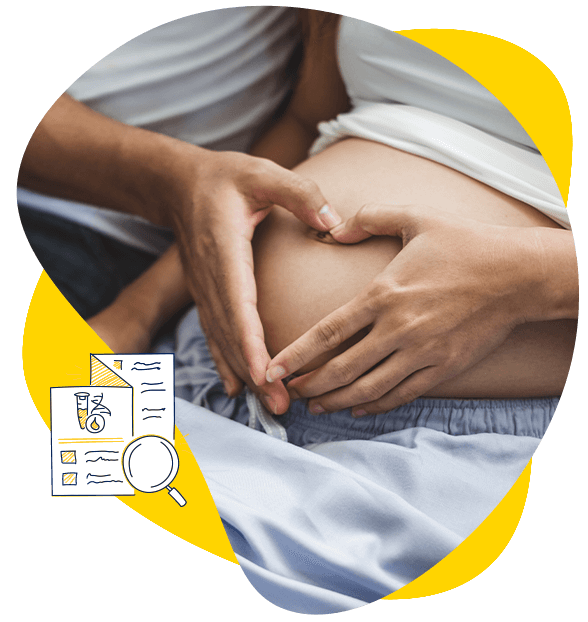

What are non-invasive prenatal tests?

Non-invasive prenatal testing (NIPT) is a safe genetic test that allows you to check your baby’s health as early as the first few weeks of pregnancy. The procedure is very simple – all that is needed is a blood sample from the expectant mother. There is no risk to either the mother or the baby.

The test involves analysing what is known as ‘free foetal DNA’, i.e. fragments of the foetus’s DNA that pass into the mother’s bloodstream from placental cells. The test checks for the presence of the most common genetic abnormalities, such as trisomy (the presence of an extra chromosome), monosomy (the absence of a chromosome) and other abnormalities in the number of chromosomes. This enables the detection of conditions such as Down’s syndrome, Edwards’ syndrome and Turner’s syndrome, amongst others.

In some cases, the free foetal DNA test may be an alternative to invasive tests, particularly in the early stages of pregnancy. Its results enable an accurate assessment of the baby’s health without the need for risky procedures. The only requirement is that the pregnancy has reached the 10th week.

Why is it worth having non-invasive prenatal tests, even if there is no family history of genetic conditions?

The primary indication for an NIPT test is abnormal results from traditional prenatal tests (ultrasound and the PAPP-A test). However, this is not the only situation in which it is advisable to opt for this screening test. This is because many of the most common chromosomal abnormalities occur spontaneously and are not linked to family history.

Non-invasive prenatal tests should be carried out by women who:

  • are pregnant and aged over 35 (in this group, the risk of genetic abnormalities in the baby increases by over 40 per cent),
  • have not undergone prenatal testing during their pregnancy,
  • have had abnormal results from prenatal tests (PAPP-A/ultrasound),
  • have previously given birth to a child with a genetic condition,
  • have been diagnosed with genetic disorders or their partners have been diagnosed with such disorders,
  • were not eligible for invasive prenatal diagnosis during their medical consultation.

Non-invasive prenatal tests make it possible to assess the health of the developing baby with remarkable accuracy at an early stage of pregnancy.

What will you find out from an NIPT test?

Thanks to NIPT (non-invasive prenatal testing), you can obtain valuable information about your baby’s genetics. The test can detect a wide range of changes in the structure and number of chromosomes by analysing the free foetal cell-free DNA present in the pregnant woman’s blood. NIPT is a highly sensitive and accurate method, whilst also offering a safe alternative to more invasive procedures such as amniocentesis or chorionic villus sampling.

  • Chromosomal abnormalities (aneuploidy) can lead to serious health problems, such as developmental delays and congenital defects, and can also contribute to a shorter life expectancy. NIPT enables the early detection of the most common genetic disorders, such as Down’s syndrome, Edwards’ syndrome and Patau’s syndrome.

  • Disorders related to the number of X or Y chromosomes can cause a number of conditions, such as Turner syndrome or Klinefelter syndrome. These abnormalities are the cause of many health problems in children (including heart defects, growth disorders, delayed puberty and fertility problems). NIPT is a test that can help detect them.

  • There is a risk of chromosomal abnormalities, such as deletions (loss of a segment) or duplications (replication of a segment). These changes can lead to various genetic syndromes (e.g. Cri-du-chat syndrome or Pallister-Killian syndrome). They can also lead to developmental disorders, such as heart defects, speech and motor skills problems, or intellectual disability. To prevent this, it is advisable to have an NIPT test whilst pregnant.

  • The NIPT test is a screening test that not only helps to detect genetic disorders and abnormalities, but also allows you to find out the sex of your baby. In boys, fragments of the Y chromosome – which is present only in male cells – are detected. In the case of girls, on the other hand, the presence of two X chromosomes is confirmed, whilst the Y chromosome is absent. Thanks to NIPT, the baby’s sex can be determined as early as the 10th week of pregnancy.

Why should you have an NIPT test at INVICTA?

At INVICTA Clinics, we make sure our patients feel safe. Our priority is to provide comprehensive medical care and to ensure that every pregnancy proceeds without complications.

blank

Convenient blood sampling

You can have blood taken for testing whilst you’re visiting your gynaecologist at any INVICTA clinic. This saves you the time you would otherwise have to spend travelling to a blood collection centre.

blank

A unique method

We offer tests to screen for triploidy (an extra set of chromosomes), vanishing twin syndrome and molar pregnancy. When you undergo testing at our clinic, you have access to a unique test that checks for single-nucleotide polymorphisms in the DNA sequence.

blank

Highest test sensitivity

You can have an NIPT test carried out at a very early stage of pregnancy without worrying about false results. The test is extremely sensitive and will provide reliable information even when the level of foetal DNA in the mother’s blood sample is very low (<2%).

blank

SNP technology

Single nucleotide polymorphism (SNP) analysis detects very small genetic variations (as small as 0.5 Mpz). This enables us to analyse foetal DNA more accurately than with other NIPT tests on offer.

blank

Online results

You will receive your results within 6–14 days of your blood sample being taken. You can view them on the medipoint.pl online platform. It’s quick, convenient and secure.

How do you take the first step?

All you need to do is book an appointment with a midwife, fill in the contact form or call our helpline and choose a convenient time for your appointment. You do not need a referral. Our blood collection centres are located in Gdańsk, Warsaw, Wrocław, Bydgoszcz, Słupsk, Gdynia and Sopot.

Before the test, you’ll receive all the necessary information about your appointment. You don’t need to fast.

During your appointment, you’ll also be told when and how to collect your results.

Book an appointment today

Which NIPT tests can you have at INVICTA?

blank

PANORAMA

PANORAMA is a prenatal test that assesses the risk of Down’s, Edwards’ and Patau’s syndromes, as well as sex chromosome abnormalities and triploidy (a condition characterised by a tripling of the total number of chromosomes). The test can be carried out from as early as the 9th week of pregnancy, in both singleton and twin pregnancies. It is completely safe, and the results may include information on the baby’s sex, if the patient so wishes.

blank

PANORAMA
+ Di George’s band

An extended version of the PANORAMA test, which, in addition to assessing the risk of Down’s, Edwards’ and Patau’s syndromes, also assesses the risk of the rare Di George syndrome. It can be carried out from the 9th week of pregnancy in singleton and identical twin pregnancies. The test is completely safe, and the baby’s sex can also be determined at the patient’s request.

blank

PANORAMA
+ micro-deletion panel

The PANORAMA test with a microdeletion panel is one of the most advanced prenatal tests. It assesses the risk of Down’s, Edwards’ and Patau’s syndromes, and also detects other rare genetic abnormalities, such as Di George’s syndrome and Cri du Chat (cat cry syndrome). The test can be carried out from as early as the 9th week of pregnancy, but only in singleton pregnancies resulting from the mother’s own egg. The test also allows the baby’s sex to be determined at the patient’s request.

blank

NIPTIFY Focus Plus

It assesses the risk of the most common genetic syndromes in the foetus, such as Down’s syndrome, Patau’s syndrome, Edwards’ syndrome and DiGeorge’s syndrome. It also analyses rare chromosomal abnormalities and partial aneuploidies >1 Mbp, and additionally enables the detection of microdeletions / microduplications in 18 clinically significant regions, as well as 3 mutations in mitochondrial DNA, associated, amongst other things, with the risk of hearing loss. It can be carried out from as early as the 10th week of pregnancy.

Read what our patients have to say about us

quote

Invicta, Gdańsk branch – an excellent antenatal clinic. I had the antenatal and genetic testing package. Professional staff who really look after the patient’s comfort. I’d highly recommend it. Very competent and professional staff.

quote

I found out about the Invicta clinic through word of mouth regarding prenatal tests. Although I arrived at the clinic quite late in my pregnancy to book the tests, the staff looked after me and did everything they could to ensure I could still have the tests done 😉 I’ve never been looked after so well by healthcare staff before. What’s more, on the very same day, the midwife took my blood straight away so I didn’t have to make several trips 😉 Their approach to patients is very professional and, I think, one worth emulating. The ladies were very kind and helpful, greeting me with a smile right at the entrance – it’s such a small gesture, yet so important ❤️☺️ I wholeheartedly recommend this clinic! Have a lovely day!☺️

quote

The staff at reception and during the examination were very friendly and helpful. The ladies were very kind and polite, and explained everything step by step regarding the tests and whilst they were being carried out. 😀

quote

All right, overall, the process of collecting the material was cosy and intimate. The staff were friendly. Best regards.

quote

I highly recommend Dr Miśta! A wonderful gynaecologist who guided my husband and me through the most difficult period of our antenatal tests. Contrary to what another gynaecologist had concluded, our daughter turned out to be healthy! Until our appointment with Dr Miśta, my husband and I were going through hell. It was only Dr Miśta’s diagnosis that put our minds at rest, and the prenatal tests confirmed it. The appointments are extremely professional; Dr Miśta explains everything and addresses every one of our concerns. You can tell she loves her work and does it for her patients, not for herself. I highly recommend her for antenatal care! As for me – I have complete trust in her and feel at ease about my pregnancy.

Frequently Asked Questions and Answers

  • NIPT (non-invasive prenatal testing) is a genetic test that analyses cell-free foetal DNA (cffDNA) present in the mother’s blood. It enables the detection of chromosomal abnormalities in the foetus, without any risk to the mother or baby. The genetic material is isolated from the mother’s blood and analysed in a specialist laboratory.

  • The NIPT test can be carried out from as early as the 10th week of pregnancy, when the level of cell-free foetal DNA in the mother’s blood is sufficient to allow for an accurate analysis. It can also be carried out later, but having the test done early allows for the earlier detection of any abnormalities, enabling doctors to plan appropriate actions and improve the chances of the best possible outcome.

  • The NIPT test can detect the most common chromosomal abnormalities, including aneuploidy, numerical abnormalities of the sex chromosomes, structural chromosomal abnormalities and other abnormalities in the quantity of genetic material in the baby.
    The range of abnormalities detected depends on the type of test chosen, so it is advisable to review the scope of the test carefully and consult your doctor before having it carried out.

  • Yes, the NIPT test is completely safe for both the mother and the baby. The test involves taking a blood sample from the mother and does not require any intervention in the foetus’s body, so it carries no risk of complications.

  • Non-invasive prenatal tests are characterised by very high sensitivity and an accuracy of 99 per cent; however, they are not diagnostic tests, but screening tests. This means that the result indicates a high probability of a particular genetic abnormality being present.

    In the event of a positive result (indicating a risk), further invasive prenatal tests may be necessary to confirm or rule out the presence of abnormalities in the foetus.

Book your appointment

Related services

Call us

Mon-Fri: 7:00 - 20:00
Sat: 7:00 - 15:00

Contact form

Have questions for us? Write. We'll call you.