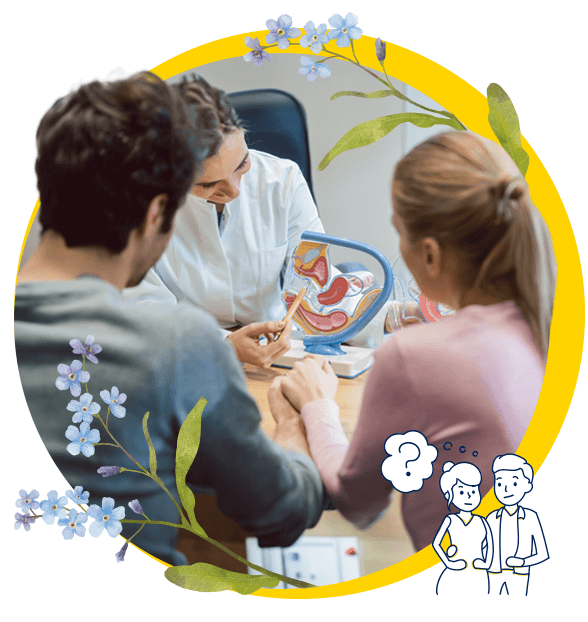
Initial diagnosis of infertility

We’re here to help you realise your dream of having a baby, guiding you through a comprehensive diagnostic process and offering personalised treatment options. Find out what we offer in terms of initial diagnostics!

Infertility – what might cause it?

During your first consultation, based on the information gathered, the doctor will attempt to diagnose the cause of your difficulties in conceiving. There can be many causes of fertility problems, and their underlying causes may vary. If the information gathered from you during the medical history interview and the first appointment proves insufficient for us to determine the cause of your difficulty in conceiving, the doctor will order further diagnostic tests to gather more detailed information and identify potential causes of infertility.


Types of infertility

  • When no identifiable cause for difficulties in conceiving can be found, this is referred to as idiopathic infertility. Idiopathic infertility is assumed when a couple, after 6–12 months (depending on the patient’s age) of regular sexual intercourse (2–4 times a week) without contraception, and with normal results from hormone and semen tests, is unable to conceive.

  • Immune infertility is often diagnosed in couples where the cause of their unsuccessful attempts to conceive is difficult to determine. A malfunctioning immune system may also be the cause of in vitro fertilisation (IVF) failures or recurrent miscarriages (at least two consecutive miscarriages, according to the guidelines of the American Society for Reproductive Medicine (ASRM)). Women with endometriosis and those with several co-existing autoimmune conditions (e.g. Hashimoto’s disease and type 1 diabetes) are also at risk.

  • The causes of secondary infertility can be classified in much the same way as the factors underlying primary infertility. Of course, factors relating to previous pregnancies and births, as well as any illnesses or injuries that one or both partners may have experienced since then, can have a significant influence on the diagnosis of the cause of conception failure.

  • Male infertility is characterised by a man’s inability to impregnate his partner after a year of regular sexual intercourse without using contraception.

  • The causes of female infertility can be divided into several categories: ovarian, fallopian tube, uterine and cervical, as well as infertility of unknown cause.

Diagnosing the causes of infertility is the key to effective treatment

If 12 months have passed (trying 2–4 times a week) without successfully conceiving, fertility problems may be suspected. In such cases, the first step should be to undergo a comprehensive diagnostic assessment. We recommend that patients who come to INVICTA Clinics undergo tests that will enable us to accurately diagnose the cause. We then select the optimal treatment plan on an individual basis, based on a detailed analysis of the test results and a medical history.

For us, initial diagnosis is

Infertility diagnosis – what tests do we carry out?

Book an appointment today

What next?

Etapy leczenia niepłodności

Our team – your experts in the field of infertility diagnosis

Our strength lies in our multidisciplinary team of specialists. We are able to devise the right solution both in cases where simple steps are sufficient and when it is necessary to employ targeted, expert methods.

blank

Dr Joanna Liss, PhD

Head of In Vitro Laboratories, Senior Clinical Embryologist

Head of In Vitro Laboratories, Senior Clinical Embryologist

blank

Dr Krzysztof Zieliński

Obstetrician-gynaecologist

Obstetrician-gynaecologist

blank

Dr Włodzimierz Sieg, MD

Obstetrician-gynaecologist

Obstetrician-gynaecologist

blank

Michał Kunicki, PhD (Med.)

Obstetrician-gynaecologist

Obstetrician-gynaecologist

blank

Dr Celina Cybulska, MD

Deputy Head of the Molecular Biology Laboratory

Deputy Head of the Molecular Biology Laboratory

blank

Dr Sebastian Pukszta, PhD (Biology)

Deputy Head of the Pre-implantation Genetic Diagnosis Laboratory

Deputy Head of the Pre-implantation Genetic Diagnosis Laboratory

blank

Dr Damian Drzyzga

Senior Data Engineer

Senior Data Engineer

blank

Krystian Zieliński

Senior AI Specialist

Senior AI Specialist

popup
quote

The most effective treatment for fertility problems is one that is planned on the basis of individual diagnostic tests carried out on both partners. Once we know the cause of the difficulties in conceiving, we can successfully select the appropriate treatment methods. That is why the initial diagnostic assessment is such an important, indeed crucial, stage.

blank
Dr Krzysztof Zieliński
Obstetrician-gynaecologist

Frequently Asked Questions and Answers

  • Initial infertility diagnosis is crucial to the effectiveness of treatment, as it enables the identification of the specific causes of fertility problems. This allows doctors to draw up a personalised treatment plan, tailored to the individual needs and specific health issues of each couple. Accurate diagnosis increases the chances of selecting the most effective treatment method, which significantly improves the likelihood of achieving pregnancy.

  • All diagnostic tests for which you receive a referral from our doctor are carried out by INVICTA Medical Laboratories.

  • Most of the tests carried out as part of infertility diagnosis are minimally invasive. Some procedures may cause slight discomfort, but they are carried out in accordance with the highest standards of care to minimise any pain. In any case, the experience may vary depending on the patient’s individual pain threshold.

  • For the convenience of our patients, we offer the option to access test results online. To do this, simply visit the medipoint.pl platform, enter your details and your test reference number. If the test has already been carried out, you’ll be able to view the result in just a few seconds. You don’t need to print them out – the results are automatically sent to your doctor at the INVICTA Clinic as well.

You might find this interesting

Call us

Mon-Fri: 7:00 - 20:00
Sat: 7:00 - 15:00

Contact form

Have questions for us? Write. We'll call you.